Politics

The Banality of Bush White House Evil

Frank Rich in the NY Times does a great job reminding us tat the Bush Whitehouse desire to invade Iraq drove so many things:

Five years after the Abu Ghraib revelations, we must acknowledge that our government methodically authorized torture and lied about it. But we also must contemplate the possibility that it did so not just out of a sincere, if criminally misguided, desire to “protect” us but also to promote an unnecessary and catastrophic war. Instead of saving us from “another 9/11,” torture was a tool in the campaign to falsify and exploit 9/11 so that fearful Americans would be bamboozled into a mission that had nothing to do with Al Qaeda. The lying about Iraq remains the original sin from which flows much of the Bush White House’s illegality.

NYC · Politics · Technology

A new car?

Maybe I can finally buy a new car?:

The Schumer-Israel approach would provide vouchers worth up to $4,000 to drivers who turn in an older car that gets 18 miles per gallon or worse and buys a new or used car that exceeds the corporate average fuel economy for vehicles in its class by 25 percent. Taken together, these two requirements guarantee considerable oil savings and significant reductions in carbon dioxide.

Politics

Going Galt? Give me a break

I have a friend who seems to believe in Ayn Rand Objectivist philosophy and talks about Tea Parties and Going Galt.
I’m guilty of not having read Atlas Shrugged though I did like this 1000 word summary of Atlas Shrugged . I certainly enjoyed this discussion from Ezra Klein
Here’s a great review from Whittaker Chambers reviewing in 1957 Ayn Rand’s Atlas Shrugged on National Review Online:

Its story is preposterous. It reports the final stages of a final conflict (locale: chiefly the United States, some indefinite years hence) between the harried ranks of free enterprise and the “looters.” These are proponents of proscriptive taxes, government ownership, labor, etc., etc. The mischief here is that the author, dodging into fiction, nevertheless counts on your reading it as political reality. This,” she is saying in effect, “is how things really are. These are the real issues, the real sides. Only your blindness keeps you from seeing it, which, happily, I have come to rescue you from.”
Since a great many of us dislike much that Miss Rand dislikes, quite as heartily as she does, many incline to take her at her word. It is the more persuasive, in some quarters, because the author deals wholly in the blackest blacks and the whitest whites. In this fiction everything, everybody, is either all good or all bad, without any of those intermediate shades which, in life, complicate reality and perplex the eye that seeks to probe it truly.

Politics

How to argue for more tax cuts

When you’re only policy solution is tax cuts, I guess you get pretty good at arguing for them. Matthew Yglesias summarizes the Republican arguments from the past decade.
From The Genius of Capitalism and the Tax Cut Debate:

There’s a certain beginner’s level of this. Here, when progressive tax policy has been in place during a period of growth, and that growth has led to a budget surplus, you argue not that it’s smart to balance the budget over the course of the business cycle, but rather that the surplus reflects the government “overcharging” in taxes that should be returned to those who pay the most taxes; which is to say to those who have the most money; which is to say to the rich. That’s a 1999 argument. Then if the economy falls into recession wiping out the surpluses, you argue that a tax cut for the rich is needed as economic stimulus. That’s a 2001 argument. And if the economy is growing during a period of conservative tax policy, you argue that the low taxes produced the growth so need to be kept in place forever. That’s a 2005 argument. And then if the economy falls into recession again, you argue that additional permanent tax cuts for the wealthy are the only solution.

News · Politics

Stimulus and the Economy

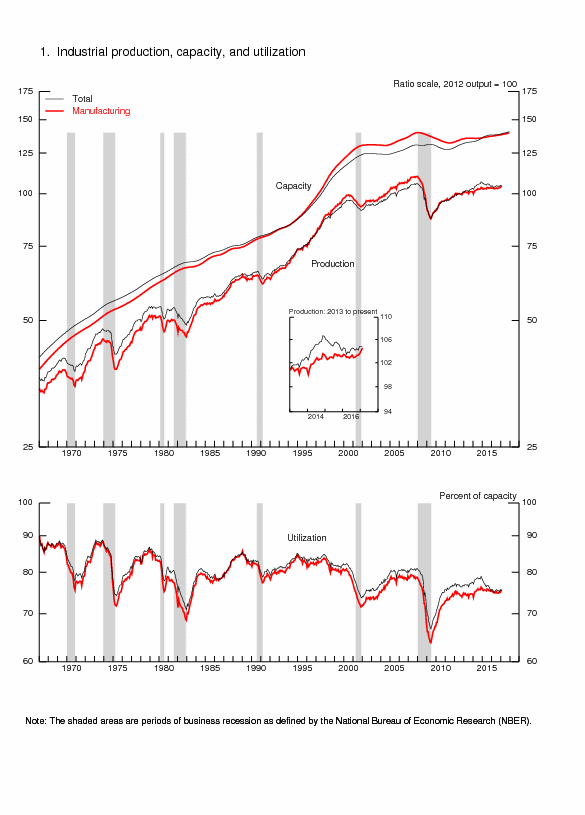
This chart from the Fed shows how far below capacity the economy currently expressed as a percentage of total capacity.
Utilization
It’s the counter argument to the proposition that the stimulus is just going to crowd out private investment. Businesses have cut back on production because of reduced demand which further reduces demand.

Politics

The White House fights back

Barack Obama has an op-ed in the Washington Post
starts to fight back at the short sighted, self-serving views that the Republicans have been using the past two weeks.
The Action Americans Need:

In recent days, there have been misguided criticisms of this plan that echo the failed theories that helped lead us into this crisis — the notion that tax cuts alone will solve all our problems; that we can meet our enormous tests with half-steps and piecemeal measures; that we can ignore fundamental challenges such as energy independence and the high cost of health care and still expect our economy and our country to thrive.
I reject these theories, and so did the American people when they went to the polls in November and voted resoundingly for change. They know that we have tried it those ways for too long. And because we have, our health-care costs still rise faster than inflation. Our dependence on foreign oil still threatens our economy and our security. Our children still study in schools that put them at a disadvantage. We’ve seen the tragic consequences when our bridges crumble and our levees fail.

I particularly liked the modest identification at the end of the article:

The writer is president of the United States.

Politics

Roubini: more bad news

  • Global, synchronized, recession.
  • Recession continues through 2009 with weak, 1%, growth in 2010.
  • Unemployment at 9% in 2010. Job losses easily at 500k/month through 2009 and may be worse. Stimulus may lower that to 200k/month.
  • $1.8 trillion loss for banks; need another $1.4 trillion for banks to recover.
  • Top 3 banks in US are technically insolvent. Nationalization only reasonable approach. Re-privatize them in 2-3 years. Otherwise, end up with zombie banks like Japan: a decade of stagnation.

  • Deficits this year: 2 trillion; next year 1.5 trillion.